Sammit and I keep a family/personal blog for baby updates and what not – I’m posting our vacation pictures over there to try and keep this blog mostly garden and food related.
Apr26
Sammit and I keep a family/personal blog for baby updates and what not – I’m posting our vacation pictures over there to try and keep this blog mostly garden and food related.

Mysterious blue flowers popping up in the new raised bed.

Tulips lining the new garden bed.

Transplanted chives coming in around the herb garden.
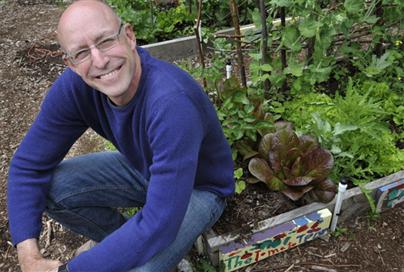
First, we have learned to see that food is not a ghetto, it is a door. You can use food to talk about the environment. You can use food to talk about culture. You can use food to talk about politics. And people took a good hard look at how their food was being produced, and they didn’t like what they saw. They didn’t like the way chemicals were being used on apples, and they didn’t like the fact that we were feeding cows to cows. But what’s driving it now is not just fear but pleasure—people have found that food gives them a lot, it gives them things that they aren’t getting elsewhere in their lives.
Head on over to one of my favorite blogs, Chiot’s Run, for a free and beautiful seed starting eBook. I already have mine! If you find it particularly helpful (which I think you will other wise I wouldn’t have shared it) then maybe think about dropping a few dollars in her pay pal donation account. She keeps her blog ad free and puts together quality material including a regular podcast!

A rewrite of Taylor Swift’s “We are never ever getting back together” featuring the Ann Arbor Farmer’s Market! You can check out more at rapforfood.org
Wayne State Urban Planning Associate Professor, Kami Pothukuchi, gives an interview about Detroit’s new urban ag ordinance and its importance to the cities’ farmers and gardeners. Click on the play button below to listen to the interview. If you live in the area and you’ve not heard of Kami Pothukuchi then please give her a good google search and check out her fantastic work.

I want to bring attention to a truthout.org article, “The Consumer’s Got to Change the System“, where Farmer Ben Burkett talks about racism and corporate control of agriculture. I thought it was a great read.
“Some say the system is working. It appears to be working fine, but corporate agriculture is not sustainable. Our system of growing food is heavy, heavy, heavy dependent on petro-chemicals, on inorganic compounds, mostly petroleum-based. And then it takes too much control out of the local community. Now, it might last for several decades, but in the end it can’t last.”
I’ll be generating some original posts soon enough. Keep with my as I finish my last semester of school, nurse yet another cold, and get used to my center of gravity changing.
…and I had such a hard time keeping it from you all.

The sober reality is that most urban agriculture projects are underfunded, understaffed, and confronted with difficult management challenges. Urban agriculture is not seen as the “highest and best use” of vacant land by most local government policy officials who would like to attract “better” tax paying uses on this land. The conventional view is that food production is something that takes place and belongs on rural land and requires a lot of it to create a profitable enterprise.
Unblight.com has a thoughtful post over on their site: “Food for Thought: The Promise and Disappointment of Urban Agriculture in Low-Income Communities“. I have rolled the questions of economically sustainable urban agriculture in my head for years now. What do you think? Is this a passing fad? Can it work without subsidies? Is the financial bottom line the only measure of an urban farm/garden’s success?
 Om-Nom Acres